Rank tracking has been one of the foundations of SEO measurement for more than two decades.
Choose a set of keywords. Check where your website ranks. Monitor whether those positions move up or down.
Behind the relatively simple dashboard, however, sits a much more complicated infrastructure.
Rank tracking platforms have to observe Google Search at enormous scale. They make searches across different keywords, devices and locations, parse the results and turn what they find into structured datasets.
For years, the economics of doing this have been relatively predictable.
Google appears to be making that increasingly difficult.
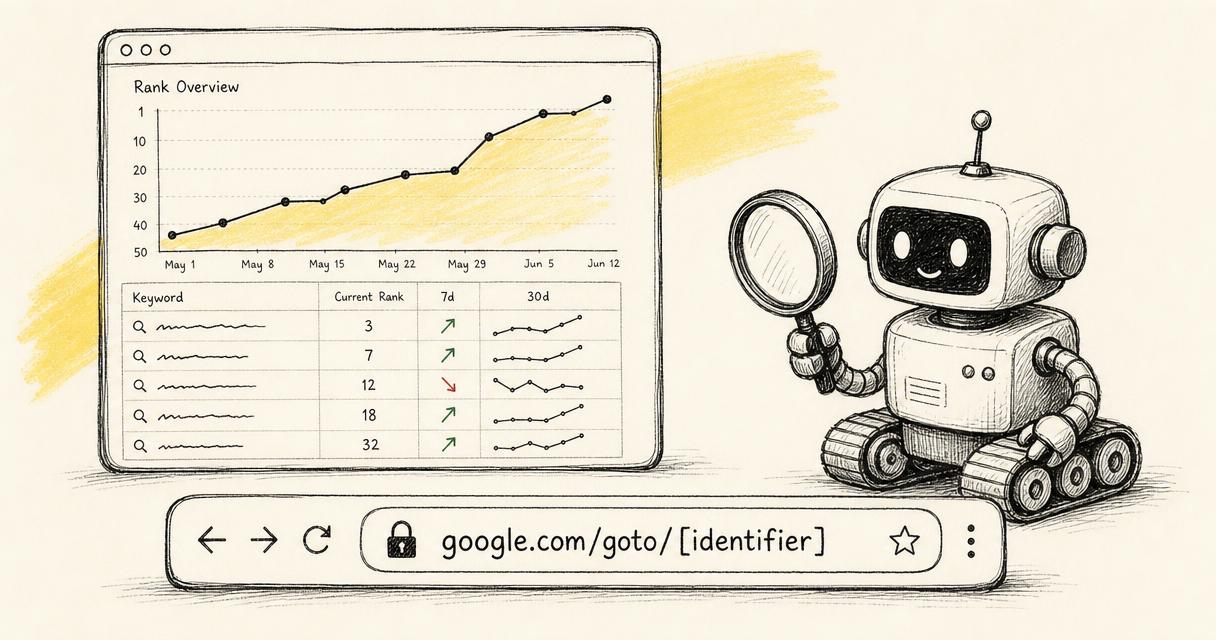
The latest change is the rollout of google.com/goto URLs within search results.
Instead of a search result always linking directly to the destination webpage, Google can now route the click through an intermediary Google URL before sending the user to the website.
Google tested the behaviour earlier this year and confirmed the wider rollout on 26 August 2026. Google described it as part of its long history of deploying technical measures against evolving forms of abuse. (Search Engine Roundtable)
On its own, that sounds like a relatively minor technical change.
Put it alongside several other changes Google has made, however, and something much more interesting is happening.
Google is slowly changing the economics of observing Google.
Rank trackers don't get their data from Google
This distinction is important.
When you open a tool and see that your website ranks fourth for a keyword, Google hasn't normally provided that ranking to the software company.
The platform has observed the search result.
At its simplest, the process looks something like this:
Query Google → retrieve the SERP → identify the results → extract the domains and URLs → record their positions
Do that for ten keywords and the infrastructure required is relatively trivial.
Do it for 10 million keywords across multiple countries, locations, devices and refresh periods and the economics become very different.
Every additional Google request costs money.
Platforms need computing resources, proxies, IP addresses, parsing infrastructure, retry mechanisms and systems capable of handling all of the different ways Google can present a search result.
This is why relatively small changes to Google's interface can have enormous consequences for SEO software companies.
First Google removed num=100
One of the clearest examples arrived in September 2025.
For years, Google's &num=100 parameter allowed tools to request up to 100 search results on a single page.
That was incredibly useful for rank trackers.
One request could theoretically tell you who occupied positions 1 through 100 for a keyword.
Google then stopped reliably supporting the parameter.
Keyword Insights explained the problem very simply at the time: retrieving 100 results could now require ten requests rather than one. (Search Engine Journal)
That creates an immediate economic problem.
Imagine a platform tracking one million keywords to a depth of 100 positions.
The infrastructure required to collect that data potentially increases enormously when Google forces the crawler to paginate through multiple sets of results.
Now multiply that across:
- desktop and mobile
- countries
- cities
- languages
- daily refreshes
- competitor datasets
- historical databases
A seemingly small change to a Google parameter suddenly matters a great deal.
Now Google is introducing goto
The latest change adds another layer of complexity.
Traditionally, a result might contain a link directly to:
example.com/product
Google can now instead provide something closer to:
google.com/goto/[identifier]
Google handles the redirect and sends the user to the intended destination.
For a normal searcher, the experience may be virtually identical.
Click the result and the correct website opens.
For automated systems trying to understand millions of SERPs, it can be much more consequential.
Search Engine Roundtable reported that the rollout appears designed to make scraping and automated extraction more difficult, although Google's own explanation only refers more broadly to measures designed to combat abuse. (Search Engine Roundtable)
If a crawler can no longer reliably obtain the final destination directly from the result link, it may need additional processing or requests to resolve it.
That potentially means:
Retrieve SERP
↓
Parse results
↓
Encounter Google redirect
↓
Resolve destination
↓
Record ranking URL
Each additional step introduces cost and potential failure.
This doesn't mean every ranking suddenly requires another click
There is an important caveat here.
Rank tracking is not about to stop working.
Google still exposes considerable information about the websites appearing within its results. Depending on the SERP structure, tools may be able to identify the domain or destination through other elements without actually following every redirect.
Engineers at Semrush, Ahrefs, Nozzle, DataForSEO, AccuRanker and other platforms are also very good at adapting to changes like this.
The problem isn't that Google has flipped a switch and killed rank tracking.
It is the cumulative friction.
Every time Google removes a convenient way of extracting results, adds another intermediary layer or strengthens its bot detection, the cost of collecting the same dataset increases.
And this is already visible.
On 27 August, a representative from rank tracker Serpdino reported seeing a spike in blocks and Google verification interstitials while adjusting its parsers to the changes. That's anecdotal rather than evidence that every provider is experiencing the same thing, but it illustrates the engineering battle taking place behind the dashboards marketers use every day. (Search Engine Roundtable)
The economics begin to compound
This is where I think the story becomes much more significant than Google's latest URL format.
Consider how SERP collection used to work.
The old model
One request could return a large number of results.
Those results contained relatively accessible destination information.
The cost per observed ranking was therefore extremely low.
Remove num=100
More requests are potentially required to collect deep rankings.
Introduce more aggressive bot detection
More requests are challenged, blocked or need retrying.
That increases proxy requirements and infrastructure costs.
Introduce goto
Extracting precise destination information potentially becomes more complicated again.
Each individual change is manageable.
Combined, they alter the unit economics.
A simplistic model for the cost of rank tracking might be:
Keywords × locations × devices × pages × retries × frequency
Increase any one of those variables and the difference can be substantial.
Increase several of them and it compounds.
This is why I don't think the right question is:
Will rank tracking still work?
It almost certainly will.
The better question is:
At what point does tracking enormous numbers of keywords to enormous depths stop being economically worthwhile?
Positions 71 to 100 suddenly look less interesting
This could change the products themselves.
SEO platforms have historically competed partly on the size of their datasets.
Billions of keywords.
Hundreds of millions of domains.
Daily tracking.
Historical rankings.
Local rankings.
Positions 1-100.
The economics made collecting huge amounts of SERP data relatively attractive.
But there is diminishing commercial value as you move deeper into a SERP.
Knowing that you rank fourth for an important commercial keyword can be extremely useful.
Knowing that you moved from position 83 to position 79 usually isn't.
If Google makes deep SERP extraction substantially more expensive, software companies eventually have to decide whether that data remains worth collecting.
That could mean:
- shallower ranking datasets
- smaller default keyword sets
- less frequent updates
- higher prices
- more premium pricing for local tracking
- greater reliance on estimated data
- more selective SERP collection
The biggest platforms can absorb more of those costs.
Smaller rank tracking companies may find the economics considerably more difficult.
It could also change how SEO teams use rankings
There is another side to this.
Perhaps marketers shouldn't be tracking as many keywords as they currently do anyway.
I've seen SEO reports containing thousands of tracked keywords simply because the technology makes it possible.
Many of those rankings have virtually no influence on a business decision.
A more useful measurement framework might involve tracking a carefully selected set of strategically important queries rather than trying to build a complete replica of Google.
For example:
- Commercial query visibility - track the searches directly connected to revenue.
- Category visibility - understand whether the brand appears across the important topics within its market.
- Competitive visibility - monitor a carefully selected group of competitors.
- Search Console performance - use Google's own first-party data to understand impressions, clicks and query visibility for your website.
- AI visibility - measure whether the brand appears within answers generated by ChatGPT, Gemini, Google AI experiences and other answer engines.
The objective isn't to know the position of every possible keyword.
It is to understand whether the brand is becoming more or less discoverable.
Those are not necessarily the same thing.
Search Console becomes more valuable
Google Search Console is particularly important within this discussion.
It doesn't need to scrape Google.
Google owns the underlying data.
That makes it fundamentally different from a third-party rank tracker.
Search Console has plenty of limitations. Positions are averaged, data can be sampled or withheld, local tracking is limited and you obviously can't use it to inspect your competitors' performance.
But when analysing your own Google visibility, it is first-party information.
I increasingly think SEO teams need to distinguish between these two things:
Search Console tells you what Google recorded about your website.
Rank trackers tell you what a third-party system observed when it queried Google.
Both are valuable.
They aren't the same dataset and shouldn't always be expected to agree.
As observing Google becomes more technically difficult, understanding that distinction becomes even more important.
And all of this is happening as search fragments
There is a broader reason I find this particularly interesting.
Rank tracking became enormously valuable because Google Search was relatively easy to model.
People typed queries.
Google returned ranked webpages.
We measured the position of those webpages.
That model is already becoming less representative of how discovery works.
A user might now research something through:
- Google Search
- Google AI Mode
- AI Overviews
- ChatGPT
- Gemini
- Perplexity
- TikTok
- YouTube
Even within Google itself, the concept of a single static ranking position is becoming increasingly difficult to apply to every search experience.
At exactly the point marketers need to broaden their measurement beyond traditional rankings, the infrastructure required to collect those rankings is becoming more expensive.
I don't think those two trends should be viewed separately.
SEO software is going to have to evolve
For years, one of the defining assets of an SEO platform was the size of its keyword index.
The bigger the database, the better the product appeared.
The next generation of search measurement may need a different philosophy.
Rather than asking:
How many keywords can we track?
we may increasingly ask:
How accurately can we understand brand visibility across the queries and platforms that actually influence customers?
That changes the measurement problem considerably.
Rank position becomes one signal among many.
So does citation frequency.
Brand mentions.
Share of voice.
Search Console impressions.
AI recommendations.
Referral traffic.
Conversions.
Revenue.
The difficult part is bringing those signals together into something that actually helps a business make decisions.
Google isn't killing rank tracking
I don't think it would be accurate to say that Google is killing rank tracking.
Not yet, anyway.
The major SEO platforms will adapt to goto.
They adapted to num=100.
They will adapt to whatever Google changes next.
But adaptation isn't free.
Every additional request, proxy, parser update, retry and engineering workaround has a cost.
And Google appears increasingly willing to impose that cost on companies attempting to observe its search results at scale.
That is the trend worth watching.
The question isn't whether we will still be able to check where a website ranks tomorrow.
We will.
The question is whether the era of cheap, exhaustive, large-scale rank tracking is beginning to come to an end.
Because if the cost of collecting traditional ranking data continues to rise at the same time that the value of a single ranking position continues to fall, the economics eventually have to change.
And when they do, the way we measure search visibility will have to change with them.