Most businesses do not have a strategy problem.
They have a friction problem.
Sales blame Marketing for poor-quality leads.
Marketing blame Sales for failing to follow them up.
Operations blame Sales for promising things the business cannot deliver.
Sales blame Operations for making the company difficult to sell.
Inside agencies, marketers complain that developers move too slowly. Developers complain that marketers treat every request as urgent.
Everybody is busy.
Everybody believes they are doing their job.
Yet growth remains harder than it needs to be.
I have seen versions of this throughout my career. Different companies, different people and different industries, but the same underlying behaviour.
Departments stop seeing themselves as parts of one commercial system.
They become tribes.
And once that happens, people begin protecting their function rather than improving the business.
The Sales and Marketing divide
The most familiar example is the relationship between Sales and Marketing.
Marketing say:
Sales do not follow up the leads.
Sales say:
Marketing do not generate the right leads.
Marketing point towards campaign performance, lead volumes, cost per acquisition and marketing-qualified leads.
Sales point towards conversations, opportunities, conversion rates and closed revenue.
Both teams can produce dashboards proving that they are doing a good job.
The business can still miss its target.
That is the problem with departmental performance metrics. They can show that an individual part of the system is functioning without showing whether the system itself is working.
Marketing can exceed its lead target while generating little meaningful pipeline.
Sales can hit a short-term revenue target while heavily discounting, selling the wrong work or creating problems for delivery.
Operations can improve efficiency while making the customer experience increasingly rigid.
Every department can win its own argument while the organisation loses.
Everyone has a different definition of a good lead
One of the simplest questions I ask is:
What is a good lead?
It sounds straightforward.
It rarely is.
Ask Marketing and they may describe a person who matches the ideal customer profile and has demonstrated a level of intent.
Ask Sales and they may describe someone with budget, authority, urgency and a clearly defined need.
Ask the Chief Executive and they may simply describe someone likely to buy profitably.
Ask the SDR team and they may focus on whether the person is willing to book a meeting.
There is nothing inherently wrong with any of these definitions.
The problem is that they are different.
When teams have not agreed what success looks like, each function creates its own version.
Marketing optimise towards one definition.
Sales qualify against another.
Management report on a third.
The resulting friction is almost inevitable.
The argument about lead quality is rarely just about leads. It is normally evidence that the business has failed to agree its commercial model.
Who are we trying to reach?
What problems are we best placed to solve?
What makes an opportunity commercially attractive?
What information does Sales need before a lead is passed across?
How quickly should it be followed up?
What feedback should return to Marketing?
Who owns the relationship at each stage?
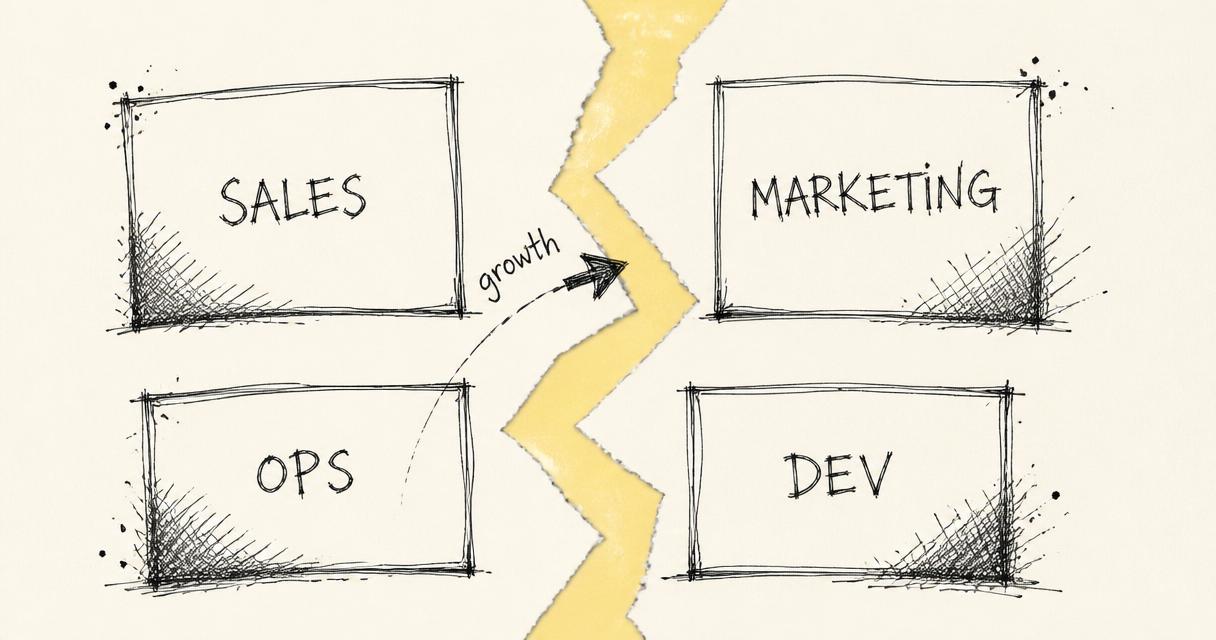
Without clear answers, the handover between Sales and Marketing becomes less like a process and more like a border crossing.
The handover is usually where growth breaks
The word "handover" itself can be part of the problem.
Marketing generate the lead and hand it to Sales.
Sales close the deal and hand it to Operations.
Operations deliver the work and hand the customer to Account Management or Customer Success.
Every handover creates an opportunity for context to be lost.
Marketing understand the message that generated the enquiry, but Sales may not.
Sales understand what was discussed during the commercial process, but Operations may receive little more than a signed order.
Operations understand the reality of delivering the service, but that learning may never make its way back into the campaigns.
Each department interacts with one portion of the customer journey.
The customer experiences all of it.
They do not care where Marketing ends and Sales begins.
They do not care whether the promise made in an advert was technically owned by one team and delivered by another.
They experience one company.
When functions fail to communicate, customers feel the joins.
Tribalism is usually modelled by leadership
It is easy to blame teams for tribal behaviour.
I think that often looks in the wrong direction.
Teams do not create organisational culture in isolation.
They learn it from their leaders.
If the Sales Director, Marketing Director and Operations Director are regularly at odds, their teams will notice.
If one leader openly criticises another function, their team receives a very clear message about how that department should be viewed.
If a Sales Director repeatedly talks about Marketing producing rubbish leads, why would the sales team respect Marketing?
If a Marketing Director describes Sales as lazy, old-fashioned or incapable of following a process, why would the marketing team treat Sales as a genuine partner?
If Operations constantly talk about the commercial teams creating problems, why would operational staff feel any ownership of growth?
Leaders create permission through their behaviour.
They give people permission to collaborate.
They also give people permission to blame.
A company can publish as many values as it likes, but people pay closer attention to what happens in meetings.
They notice who receives praise.
They notice who gets blamed.
They notice how leaders talk about one another when those people are not in the room.
A Chief Executive can speak about "one team" at a company meeting, but if the senior leadership team behaves like a collection of competing interests, the rest of the organisation will follow.
Culture does not cascade from posters.
It cascades from behaviour.
"We" and "they"
The language used by leaders matters more than many people realise.
Consider the difference between these statements:
We need to improve the way we qualify and follow up enquiries.
And:
Marketing need to stop sending us bad leads.
The first statement frames the issue as a shared commercial problem.
The second assigns blame to a tribe.
The same is true when someone says:
Development are blocking the campaign.
Or:
Sales have sold something we cannot deliver.
Or:
Operations are making this unnecessarily difficult.
There may be legitimate issues behind each statement.
But the language determines how people approach them.
"We" encourages problem-solving.
"They" encourages defensiveness.
Once departments begin talking about one another as though they are external suppliers, collaboration has already started to break down.
The more niche divide between Marketing and Development
The Sales and Marketing divide receives most of the attention.
Within agencies, I have also seen a more niche but equally damaging form of tribalism between marketing and development teams.
The two functions often operate with completely different mental models.
Marketing value speed, experimentation and responsiveness.
A campaign may need to launch around a particular event, season, media opportunity or change in demand.
The marketer sees a landing page, a tracking update or a website change as a relatively small request that could unlock revenue.
Development teams value reliability, maintainability, security and technical quality.
They are thinking about deployment processes, testing, browser compatibility, accessibility, performance, integrations, technical debt and the long-term consequences of adding another feature.
The marketer says:
It is only a small website change.
The developer hears:
Please introduce another unplanned requirement into a system you are responsible for maintaining.
The developer says:
That cannot be completed this sprint.
The marketer hears:
The business opportunity is not important.
Neither interpretation is necessarily fair.
Both are usually shaped by a limited understanding of the other function.
"Just add a landing page"
Anyone who has worked in an agency will have heard some variation of:
Can we just add a landing page?
To a marketer, the requirement might appear simple.
A headline.
Some supporting copy.
A form.
A few testimonials.
Perhaps a new tracking event.
To a developer, that request may involve decisions about templates, content management, responsive behaviour, form handling, consent, CRM integration, analytics, testing and deployment.
The problem is not that Marketing should stop asking for landing pages.
Nor is it that Development should build everything immediately.
The problem is that each team often sees only its own side of the request.
Marketing see the potential commercial upside.
Development see the implementation cost and technical risk.
A good decision requires both.
The SEO and Development relationship
The relationship between SEO and Development is another good example.
An SEO specialist may identify problems with internal linking, JavaScript rendering, faceted navigation, structured data, redirects, page speed or indexation.
From their perspective, the technical issue may be restricting the visibility of thousands of pages and suppressing a meaningful amount of revenue.
A developer may receive the same recommendation as another ticket competing against product features, security updates, bug fixes and client commitments.
They may also receive a recommendation that is technically vague, poorly scoped or based on an idealised view of how the website should work.
The SEO specialist thinks the developer does not understand search.
The developer thinks the SEO specialist does not understand the platform.
Sometimes both are right.
More often, neither has been given the environment or incentive to understand the other.
Functional empathy
The antidote to this is not that everyone should become a generalist.
Businesses still need deep specialists.
A developer does not need to become an expert in demand generation.
A marketer does not need to understand the entire application architecture.
A salesperson does not need to know how every campaign is configured.
But they do need functional empathy.
I define functional empathy as:
The ability to understand the incentives, pressures, constraints and objectives of another function well enough to make better decisions within your own.
It is not about agreeing with every request.
It is about understanding where the request comes from.
A marketer with functional empathy understands that an apparently simple change may create technical complexity and ongoing maintenance.
They provide clearer requirements, explain the commercial context and involve developers earlier.
A developer with functional empathy understands that timing may be commercially important.
They do not simply reject a request on technical grounds. They help identify the fastest responsible route to achieving the intended outcome.
A salesperson with functional empathy understands that lead generation is not a vending machine.
They provide specific feedback instead of declaring that the leads are poor.
A marketer with functional empathy understands that lead volume is meaningless if Sales cannot convert it.
They listen to calls, review lost opportunities and adjust campaigns based on what happens after the form is submitted.
Functional empathy does not remove healthy tension.
It makes that tension productive.
Good friction and bad friction
Not all friction is harmful.
Good businesses need challenge.
Marketing should challenge Sales on follow-up.
Sales should challenge Marketing on qualification.
Operations should challenge unrealistic commercial promises.
Development should challenge poor technical decisions.
The objective is not to create a culture in which everyone agrees.
The objective is to ensure disagreement remains focused on the problem.
Good friction sounds like:
What evidence supports this decision?
What would need to be true for us to prioritise this?
Is there a smaller version we could test first?
What impact would this have on customers and revenue?
What information are we missing?
Bad friction sounds like:
That team never understands.
This is not our problem.
They always do this.
We told them it would not work.
The distinction is simple.
Good friction improves the decision.
Bad friction protects the tribe.
Incentives create the behaviour
Tribalism is not only cultural.
It is often designed into the organisation through targets and incentives.
If Marketing are judged solely on lead volume, they will optimise for lead volume.
If Sales are judged solely on closed revenue, they may prioritise deals regardless of profitability, fit or delivery complexity.
If Development are judged solely on completing planned work, unplanned commercial requests become a threat to their performance.
If Operations are judged solely on efficiency, flexibility becomes a cost.
People usually behave rationally within the system they have been given.
The problem is that departmental incentives can produce irrational outcomes for the wider business.
This is why shared measures matter.
Functions can retain their specialist metrics, but they should also be accountable for outcomes that cross departmental boundaries.
Pipeline quality.
Speed to lead.
Opportunity conversion.
Gross profit.
Retention.
Time to value.
Customer satisfaction.
Revenue should not belong only to Sales.
Customer experience should not belong only to Operations.
Lead quality should not belong only to Marketing.
These are shared outcomes produced by a connected system.
Growth lives between functions
Some of the biggest growth opportunities I have found did not sit neatly inside a department.
They existed between them.
A campaign generated demand, but the follow-up process was too slow.
Sales were booking customers, but the onboarding experience was creating early churn.
Marketing had identified an opportunity, but Development had not been involved early enough to make the delivery practical.
Operations had valuable customer insight, but it was not being used in messaging.
Sales conversations contained repeated objections, but those objections were not being fed back into content or product development.
No single function was necessarily failing.
The connections between them were.
That is why I believe growth should be treated as a system rather than as another name for Marketing.
The role of a Chief Growth Officer
The Chief Growth Officer role is often misunderstood.
In some businesses, it is effectively a more senior Marketing Director.
I think that misses the point.
A Chief Growth Officer should work across Sales, Marketing and the operational functions that influence acquisition, conversion, delivery and retention.
Their role is not to defend Marketing.
It is not to manage Sales from a distance.
It is to create the fluidity, communication, operational discipline and collaboration required for growth.
They should be able to ask:
Where is revenue being lost?
Where is the customer journey breaking?
Where are teams working towards conflicting objectives?
Where is context disappearing between functions?
What is preventing the organisation from moving faster?
Sometimes the constraint will be demand generation.
Sometimes it will be sales capability.
Sometimes it will be pricing.
Sometimes it will be delivery capacity.
Sometimes it will be onboarding, retention, product quality or customer experience.
Growth does not care which department owns the bottleneck.
It cares whether the bottleneck is removed.
A strong Chief Growth Officer should therefore sit alongside the leaders of Sales, Marketing and Operations, not simply above one function while observing the others.
They need enough authority to challenge functional targets, resolve competing priorities and keep teams focused on the same commercial outcome.
Just as importantly, they need to model the behaviour they expect from the wider organisation.
No favourites.
No public blame.
No protecting one department at the expense of another.
The role should create alignment without removing accountability.
Leadership partnerships are visible
Senior leadership relationships are never as private as leaders imagine.
Teams can tell whether two directors trust one another.
They can tell whether meetings are collaborative or territorial.
They can tell whether a decision has been genuinely agreed or reluctantly accepted.
When leaders present a united partnership, their teams are more likely to work together.
That does not mean hiding disagreement.
Healthy leadership teams can debate strongly.
But once a decision is made, they should communicate it consistently and take collective ownership.
A Sales Director should be able to explain the value of Marketing.
A Marketing Director should understand the pressures facing Sales.
An Operations Director should be included early enough to shape commercial promises rather than simply being expected to fulfil them.
When functional leaders visibly respect one another, that behaviour spreads.
When they undermine one another, that spreads too.
Every leadership interaction teaches the organisation how it is expected to behave.
Customers experience your organisation chart
Conway's Law is usually discussed in relation to software.
The basic principle is that organisations tend to design systems that reflect the way they communicate.
I think the same logic applies to the customer journey.
If Marketing, Sales and Operations are disconnected internally, the experience will feel disconnected externally.
Marketing will make promises that Sales do not recognise.
Sales will make commitments that Operations cannot fulfil.
Customers will repeat information at every stage.
Account teams will discover expectations that were never documented.
The brand will sound different depending on which department is speaking.
Customers experience the communication structure of the business whether the business intends them to or not.
Your internal friction eventually becomes their external frustration.
Removing the borders
Departments are necessary.
Specialism matters.
Clear accountability matters.
The answer is not to remove functional structures or pretend everyone owns everything.
The answer is to stop those structures becoming borders.
That requires shared commercial definitions.
It requires connected processes.
It requires feedback moving in both directions.
It requires incentives that do not encourage one department to succeed at another's expense.
It requires leaders who speak about other functions with respect.
And it requires functional empathy throughout the organisation.
The best marketers I have worked with understand the realities of Sales and delivery.
The best salespeople understand how demand is created.
The best developers understand the commercial importance of their work.
The best operational leaders understand that growth is not something inflicted on the business by the commercial team.
They do not abandon their specialism.
They understand how it connects.
The real competitive advantage
Businesses spend a great deal of time looking for new channels, technology and tactics.
They invest in better CRM systems, more automation, new reporting platforms and increasingly sophisticated uses of AI.
Those things may help.
But technology will not fix a leadership team that does not trust one another.
A CRM will not create a shared definition of a good lead.
A project management platform will not make Marketing and Development respect each other's constraints.
A dashboard will not stop departments manipulating their own metrics.
Internal friction is often treated as a cultural inconvenience.
It is a commercial cost.
It slows decisions.
It weakens execution.
It creates duplicated work.
It damages morale.
It makes customer experiences inconsistent.
It causes good opportunities to disappear between functions.
While one company spends weeks arguing about who owns a problem, another solves it.
That, to me, is the real opportunity.
The businesses that grow fastest will not always be those with the most talented individual departments.
They will be the businesses that connect those departments most effectively.
Growth rarely belongs to one function.
More often, it lives in the space between them.